Trying to conceive after miscarriage: When is the ‘right time’?
16th December 2025
Experiencing a miscarriage can be physically and emotionally overwhelming. For many, it involves significant physical symptoms and evokes an immense sense of grief, as well as other psychological effects. Understandably, you may wonder if, and when, it is ‘safe’ to try to conceive again.
Some people want to try again soon after a miscarriage, while others need more time. Deciding whether to try again after pregnancy loss can be very difficult and you will likely have mixed emotions about another pregnancy.
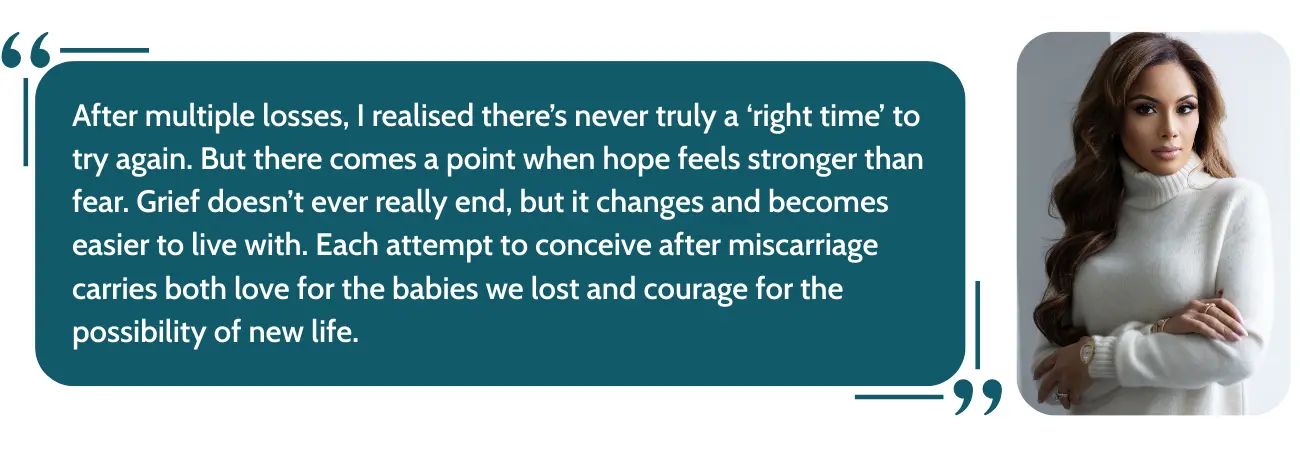
Our ambassador, Nisha Begum-Reedtz, reflects on her losses and decision to try again:
You might want to become pregnant again quickly. However, you might also fear another loss. Sometimes, medical considerations will mean it’s out of your control. Here we provide information to help support your decision-making about the right time for you to start trying for another pregnancy.
Please note that this is intended as guidance only, and we encourage you to speak with your health professional about your individual situation.
How soon can you try again?
Physical Recovery
After one uncomplicated miscarriage, there is usually no routine follow-up in the UK, and your physical recovery may be straightforward. Medical advice can vary, and this often leaves women unsure of when it is safe to try to conceive again. If you have underlying health issues, or have experienced second trimester loss, miscarriage complications, recurrent miscarriage, ectopic or molar pregnancy, it’s best to speak to your doctor first.
In most cases, the ‘best time’ to try is when you and your partner feel physically recovered and emotionally ready to embark on another pregnancy. Research shows that there is good evidence to suggest that there is a lower risk of miscarriage in women who conceive within the first six months after a miscarriage, however, this doesn’t mean you should feel that you have to rush into trying again.
The current advice from GPs and Early Pregnancy Units (EPUs) is to wait until bleeding has stopped before having sexual intercourse, to help reduce the risk of infection. It is also recommended to take a pregnancy test before trying again, as a positive result could suggest further follow-up is needed. Various sources, including the NHS, the World Health Organisation (WHO) and the Royal College of Obstetricians and Gynaecologists (RCOG), suggest waiting until after one normal period before trying again. This helps:
1. With clearer dating of any future pregnancy.
2. To allow your body time to recover, including hormone levels and the lining of the uterus.
Your period usually returns within 4–6 weeks after a miscarriage, though for some it may take longer. You can ovulate before your next period, so contraception is advised if you’re not ready to conceive. However, if you do become pregnant before your next period, recent evidence suggests that it doesn’t increase the risk of miscarriage, provided you are physically well.
Underlying health conditions
If you have a known health issue, it is important to discuss this with your doctor before trying again. Managing/treating underlying conditions can improve the chances of a successful pregnancy. This is because some conditions can make miscarriage more likely, such as diabetes and thyroid disorder. Some people experience infection after miscarriage, particularly following surgery. If infection occurs, it is important that this is treated and your body has fully recovered before trying again. This reduces the risk of complications in a subsequent pregnancy. Untreated, severe anaemia can affect fertility and pregnancy outcomes. If you’re feeling tired, breathless or weak, we recommend asking your GP for a blood test to check your iron levels. It’s important to ensure your iron levels are back to normal before conceiving. This can take several months; however, it is something that is usually easily treated.
Recurrent Miscarriage
If you have experienced multiple miscarriages, testing should be offered to help identify any underlying causes. Recurrent miscarriage is typically diagnosed following three or more miscarriages, even when you have had healthy pregnancies in between. However, sometimes testing is conducted after two losses, notably for women in their late 30s/40s, when it has taken a long time to conceive and/or your GP suspects there may be an underlying issue. If you have endured two losses and do not qualify for testing, you could still seek a second opinion. When you’re undergoing investigations, you may be advised to wait until they’re complete before trying to conceive again, which can be very difficult.
Results may reveal a treatable cause (e.g., a blood clotting disorder), however, they can come back as ‘unexplained’ or inconclusive. When a reason is given, this can help some women to try to conceive again because they feel that their issue is being managed/treated. However, this is not always the case. Either way, it may be reassuring to know that most women are more likely to have a successful subsequent pregnancy than to miscarry again. It can be very distressing to go through repeated miscarriages.
You might be determined to keep on trying. However, there may come a time consider other options. Deciding to stop trying can be extremely difficult, and we have a dedicated leaflet to support you with this; When the Trying Stops.
Second Trimester Loss
If you experience a loss in the second trimester (between 13 and 24 weeks), you should be offered investigations to explore potential causes. These tests might provide answers, although sometimes no clear cause is found. A follow-up appointment is usually arranged where you can talk through the results and any treatment that might help in a potential future pregnancy.
Your GP, midwife or consultant can help you to plan for another pregnancy if/when this feels right for you, and you may be offered additional care within a subsequent pregnancy which can be reassuring, such as extra scans or check-ins. You may also be referred to mental health support services which can help with processing your loss.
Molar Pregnancy
After a molar pregnancy, medical follow-up care is essential. You may be asked to wait several months, or longer, before trying again which can prove very difficult. This is to make sure there’s no regrowth of molar tissue. A new pregnancy could mask the regrowth of molar cells and make them very difficult to detect and treat.
If chemotherapy is needed, a longer wait (up to 12 months after you have finished treatment) may be advised before trying to conceive. It is a long time to wait, and this can be extremely difficult in addition to the already distressing diagnosis, but it helps to ensure that you are safe.
A molar pregnancy does not affect your fertility and many women go on to have a successful pregnancy after this type of loss. You are also unlikely to have another molar pregnancy.
Ectopic Pregnancy
After an ectopic pregnancy, most doctors recommend waiting to try again, notably until you’ve had at least two normal periods following surgical or expectant management, or waiting 3 months if you received medical treatment (methotrexate).
Successful conception following an ectopic pregnancy is dependent on many factors, such as the health of your fallopian tube(s) and age. However, the Ectopic Pregnancy Trust states that statistically, the chances of having a subsequent successful pregnancy are very high and 65% of women are healthily pregnant within 18 months of an ectopic pregnancy, rising to around 85% over two years.
If you have had a previous ectopic pregnancy your EPU should offer you an early scan from around 6 weeks of pregnancy to find out if the new pregnancy is developing in the right place. So, once you have a positive pregnancy test it is best to let your GP or EPU know so that they can get a scan planned for you.
Other factors
Fertility Treatment
Miscarriage after fertility treatment can be especially difficult as the decision to try again may be shaped by emotional recovery, physical health, finances and the advice of your fertility specialist. Some people feel pressure to move forward quickly, but it’s okay to take your time and you may want to allow your body time to heal, ensuring your hormone levels return to normal and your menstrual cycle stabilises before proceeding with another IVF cycle. The grief of miscarriage, combined with the demands of IVF, can be overwhelming. The decision is yours (and your partner’s) alone. It may be beneficial to receive counselling to help you to process your experience and feel more ready, when the time is right for you. Find a specialist counsellor here.
Age
Age can be a factor in how soon you want, or feel the need, to try again. You might find it helpful to talk through your concerns with a GP or counsellor. The Miscarriage Association provide invaluable resources to support you as well. Find a specialist counsellor here.
Partners and Relationships
Partners may cope differently and be ready to try again at a different time to you. Sometimes relationships break down following miscarriage. It may be that you have entered a new relationship with someone who has not experienced miscarriage, which can make it difficult for them to fully comprehend your experience and how you are feeling.
Communication, including honest conversations, showing empathy and sometimes professional support like couples counselling, can be very beneficial.
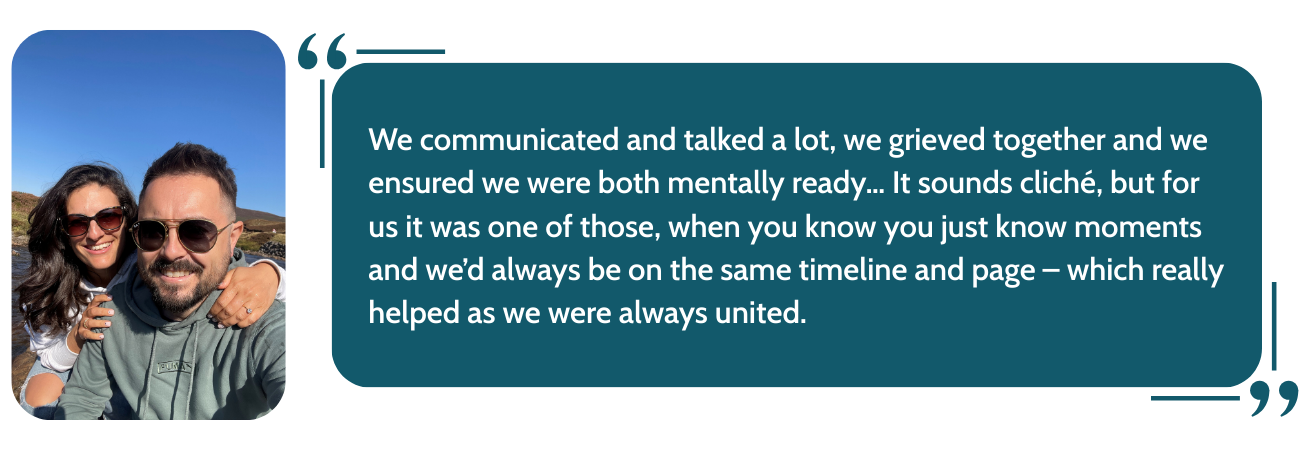
Natasha and Chris share their approach to trying again:
The Miscarriage Association have a counselling directory which lists specialist counsellors in this area. They also offer support via telephone, email and forums for partners.
Ways to support your emotional healing
The emotional impact of miscarriage can be long-lasting and unsurprisingly influences trying to conceive again after a loss. When trying to conceive, each month can feel like a rollercoaster of emotions, marked by anticipation, uncertainty and anxiety.
Pregnancy after loss, and trying again, can bring a complex mix of feelings – here, Natasha and Chris describe what they felt on their journey:
Coming to the decision to try again is a whirlwind because you always have that thought that it could happen again. And in our case as we had multiple miscarriages, if felt like the odds of miscarrying again became higher each time. You see the positive pregnancy test come up and you’re so happy, but you overthink every symptom – or lack of symptoms you might be having. You wonder if everything is ok. Every time you use the toilet you check the toilet paper for any signs – it’s a constant battle in your mind knowing the best thing for you and the baby is be positive but it’s hard. And when and if you reach 12 weeks, your body is filled with nerves wondering if you’ll hear those dreaded words again.
Some people may become preoccupied with monitoring ovulation and timing intercourse, which can heighten anxiety. Others may be concerned about their diet and environmental factors and feel quite out of control. If you’re struggling emotionally, support is available. While we don’t offer formal counselling directly, we provide a wealth of information and support, including our specialist helpline, live chat and online support.
Counselling
Speaking to a counsellor or therapist can help, particularly if you’ve experienced trauma. Approaches such as trauma-informed Cognitive Behavioural Therapy (CBT) or Eye Movement Desensitisation and Reprocessing (EMDR) can be effective for PTSD, reducing anxiety and allowing you to process your loss. Often women find counselling useful to build emotional resilience, and this can enable them to try again. It is important that ongoing mental health support during a subsequent pregnancy is provided. Psychological support should be readily available during pregnancy through your GP or midwife. We have a counselling directory of professionals with experience in pregnancy loss, accessible here.
Peer support
In addition to counselling, it may be helpful to talk to people in similar situations. Our Facebook and support groups might help you to feel less alone and can allow you to offload your anxieties. Podcasts or blogs about pregnancy loss might also help.
Self-care
Trying to conceive after pregnancy loss can be a stressful time, and so finding space for ourselves can be important. Gentle exercise such as swimming and walking, being in nature, meditation and journaling can all help to reduce anxiety after loss.
Pregnancy guidance
Lastly, although we cannot control a positive pregnancy outcome, following pre-pregnancy and pregnancy guidance is advised. We recommend following the NHS guidelines for conception and pregnancy, for example, foods to avoid, supplements to take and more. This may also help you to feel some element of control.
When to speak to your GP
Please see your doctor if you:
- Have difficulty conceiving again
- Have experienced two or more miscarriages
- Notice changes in your health or menstrual cycle
- Feel anxious, panicked or low in mood
In Summary
In most cases, it is safe to try again for another pregnancy after one normal menstrual cycle. However, certain types of loss may require a longer wait. It’s important to check any underlying health concerns with your GP before trying again and that you consider your (and your partner’s) physical and emotional health. Positively, most women go on to have a healthy pregnancy after a pregnancy loss. However, it is not an easy time and support is available. You don’t have to go through this alone.
This information is provided as guidance only and does not replace medical advice.